
Custom Trailer Coupler Guide: Types, Uses, and Installation Tips
Have you ever been frustrated when a mismatched trailer coupler caused delays during a crucial trip or on the construction site? Choosing the appropriate custom trailer coupler is important for safety, efficiency, and avoiding expensive malfunctions in addition to compatibility. This thorough book covers all the information you want to ensure that your towing operations are always successful, from comprehending the many varieties to becoming an expert in installation procedures.

Understanding Custom Trailer Couplers and Their Critical Role
The crucial link between your towing car and trailer is a bespoke trailer coupler, and selecting the incorrect one might jeopardize both performance and safety. A bespoke trailer coupler, in contrast to conventional off-the-shelf choices, is specially designed to satisfy certain load requirements, vehicle characteristics, and operating circumstances. These specialist parts provide a snug fit that generic couplers just cannot offer by taking into consideration elements like tongue weight capacity, ball size compatibility, and mounting design. Custom trailer couplers are crucial pieces of equipment when conventional solutions are insufficient because of heavy-duty uses, unique trailer designs, or particular industry needs. Custom trailer couplers are manufactured using precision metal fabrication methods such as advanced welding, laser cutting, and CNC machining. Depending on the intended use and environmental factors, high-quality producers use materials ranging from mild steel and stainless steel to aluminum alloys. Beyond only measurements, the customisation includes locking mechanisms, safety features, load ratings, and surface treatments like plating, anodizing, or powder coating that prolong service life and prevent corrosion. Operators and fleet managers may make well-informed choices that directly affect operational safety and efficiency by having a solid understanding of these principles.
Key Components of Custom Trailer Coupler Systems
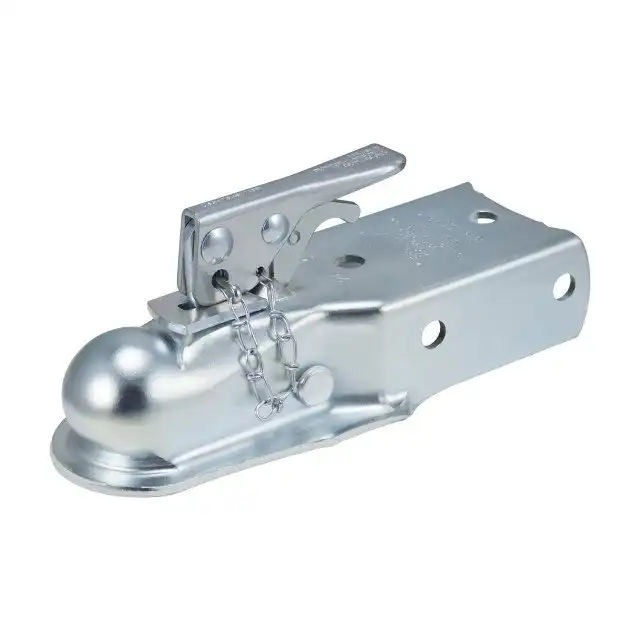
In order to establish a safe towing connection, each unique trailer coupler system is made up of a number of interconnected parts. The major structure of the coupler is the body itself, which is usually made of high-strength steel using deep drawing or progressive stamping techniques that preserve material integrity while producing the desired shape. For dependable engagement and release, the latch mechanism—which fastens the coupler to the tow ball—must be designed. Safety chains or other locking elements are sometimes included for redundancy. The mounting bracket, which joins the coupler to the trailer tongue, has to disperse loads uniformly to avoid failure-causing stress concentrations. Adjustment elements that take into account changes in vehicle height and tongue angle are also included into custom trailer coupler designs. Tire wear, braking performance, and handling qualities are all directly impacted by these modifications, which guarantee the trailer stays level throughout transportation. By adding integrated brake actuators, electrical connectors, or hydraulic connections, advanced custom couplers may change from being a straightforward mechanical connection to a complex interface that manages many trailer systems. The lifetime and general dependability of the towing system are determined by the quality of each component and how well they work together.
Material Selection and Manufacturing Standards
When choosing materials for bespoke trailer couplers, manufacturing compatibility, environmental resistance, and mechanical qualities must all be carefully taken into account. Cold rolled steel is perfect for moderate-duty applications because it has good strength-to-weight ratios and easily accepts welding. Although stainless steel is more expensive and needs specific welding procedures, it offers higher corrosion resistance for chemical exposure or maritime settings. While coated steel combines the strength of steel with improved environmental protection via galvanizing or powder coating processes, aluminum alloys provide substantial weight reductions for instances where tongue weight impacts total vehicle capacity. From raw material requirements to final inspection procedures, manufacturing standards regulate every facet of the manufacture of bespoke trailer couplers. While ISO 14001 tackles environmental concerns in production, ISO 9001 certification guarantees constant quality control throughout the manufacturing process. Before items are delivered to clients, reputable manufacturers use thorough testing methods to confirm load capacity, fatigue resistance, and structural integrity. These standards are tried-and-true procedures that shield end users from potentially disastrous device breakdowns and are more than just bureaucratic regulations.

Types of Custom Trailer Couplers for Different Applications
Due to the wide range of towing applications, several specialized trailer coupler designs are required, each of which is suited for particular operating needs. The most popular type is still the standard A-frame coupler, which has a simple yet efficient construction that can handle the majority of light to medium-duty trailers. These couplers accommodate conventional ball sizes between 1-7/8 and 2-5/16 inches and attach straight to the trailer tongue. They have load limits between 2,000 and 15,000 pounds gross trailer weight. Because of their simplicity, A-frame designs are affordable for bespoke construction and reliable in a wide range of towing situations. Mismatched vehicle and trailer heights are a typical problem that may be solved using adjustable-height custom trailer couplers. Operators may raise or lower the coupler in relation to the trailer tongue thanks to the mechanical or hydraulic adjustment mechanisms included into these intricate designs. When a single trailer has to communicate with many towing vehicles or when loading circumstances drastically change the distribution of tongue weight, this adaptability comes in very handy. Precision CNC machining is needed to manufacture these adjustable systems in order to guarantee smooth adjustment action and dependable locking in any position, avoiding unanticipated movement during transportation that might jeopardize stability.
Heavy-Duty Custom Trailer Coupler Solutions
Custom trailer couplers designed to endure high loads and challenging working conditions are necessary for heavy-duty applications. These specialist couplers use reinforced construction methods, such as multi-plane load distribution designs that avoid stress concentration, thicker base materials, and significant gusseting. To ensure constant quality in these crucial components, manufacturers often use robotic welding in conjunction with progressive stamping. The coupling mechanisms itself include redundant locking systems, reinforced steel structure, and larger pins that prevent unintentional disengagement even under dynamic loading circumstances seen in industrial transport, construction, and agricultural applications. Heavy-duty bespoke trailer couplers include surface treatments that go beyond simple corrosion prevention to include wear-resistant coatings that preserve dimensional correctness even after several coupling and uncoupling cycles. While thermoplastic coatings provide impact resistance that guards against the physical damage typical in tough industrial conditions, electrophoresis coatings offer greater adherence and consistent coverage even in complicated geometries. In addition to prolonging component life, these finishing techniques preserve the precise tolerances required for safe functioning over many years of use. These heavy-duty bespoke trailer couplers are supported by high-quality manufacturers that provide thorough testing data to confirm performance in operationally realistic scenarios.
Specialty Custom Trailer Coupler Designs
Custom trailer coupler designs that differ greatly from conventional arrangements are necessary for several sectors. Couplers made completely of brass or stainless steel with specific coatings that prevent corrosion in seawater may be required for marine applications. Couplers with built-in hydraulic quick-connects or PTO shaft guards that simplify equipment changes are often advantageous for agricultural equipment. Applications for recreational vehicles may call for lightweight aluminum construction with built-in break-away safety features and surge brake actuators. Custom fabrication uses customized design and material choices to handle the particular technical problems presented by each specific application. Specialty trailer coupler modification starts with a thorough examination of operating requirements, such as load profiles, environmental factors, the necessity for regulatory compliance, and equipment integration. Before committing to production, engineers improve designs using sophisticated CAD modeling to make sure that bespoke solutions satisfy all functional requirements while also being manufacturable. Before full-scale manufacturing starts, designs are validated by prototype manufacture and testing, which might reveal possible problems that theoretical study could miss. By producing solutions that really meet client demands rather than shoving applications into poorly fitting conventional items, this rigorous development process sets professional custom trailer coupler manufacturers apart from competitors that only tweak common components.

Installation Tips for Custom Trailer Couplers
Custom trailer couplers must be installed correctly since doing so directly affects performance and safety. The first step is to precisely measure and mark the trailer tongue's mounting points. To avoid unequal load distribution and handling issues, the coupler must precisely line up with the centerline of the trailer. With nuts and lock washers on the other side, Grade 8 bolts that fully penetrate the trailer tongue are used to install the majority of bespoke trailer couplers. Unless the coupler is designed especially for welded installation, never utilize welds as the only mounting technique since heat-affected zones might impair structural integrity in unexpected ways. Make that the chosen mounting point has sufficient clearance for the coupler's entire range of motion during articulation before drilling any holes. The coupler must be allowed to rotate without coming into touch with the jack stand, trailer tongue, or other parts. Make sure the mounting region has enough material thickness and structural stability, and take into account the trailer's loaded tongue weight. For tongues with thinner walls, reinforcement plates could be required in order to properly distribute mounting stresses. To ensure that bolts acquire the correct preload without overtightening, which might damage threads or deform the coupler mounting surface, professional installers often utilize torque wrenches calibrated to manufacturer standards.
Alignment and Adjustment Procedures
After mounting hardware is in place but before final tightening, perform alignment verification to ensure the custom trailer coupler operates correctly. With the trailer level, measure the coupler's height from the ground and compare it to your towing vehicle's ball mount height. Ideally, these should match within one inch to maintain proper trailer attitude during transport. Adjustable couplers offer flexibility here, but even fixed couplers can be shimmed using properly rated spacers if minor height corrections are needed. Check that the coupler latching mechanism operates smoothly through its full range of motion, neither binding nor exhibiting excessive play. Electrical and hydraulic connections, if present on your custom trailer coupler, require careful routing to prevent damage from road debris, pinching, or excessive flexing. Use appropriate strain reliefs and protective conduit where wiring or hydraulic lines exit the coupler assembly. Test all integrated systems before the first loaded trip, verifying that trailer brakes, lights, and auxiliary functions operate correctly. Safety chains should attach to the trailer frame using appropriate grade fasteners, positioned to cross under the coupler tongue in an X-pattern that will support the tongue if the coupler fails. These chains represent the last line of defense against trailer separation and deserve the same careful attention as primary mounting hardware.
Maintenance and Inspection Protocols
Frequent maintenance prolongs the service life of bespoke trailer couplers and guards against unplanned malfunctions that can cause mishaps or cargo loss. Establish a regular inspection plan depending on the frequency of use. After each significant trip, or at least once a month for trailers that are used regularly, examine for obvious cracks, excessive wear, or deformation. High-stress regions, such as the latch mechanism, weld seams, and mounting bolt holes, need special care. As directed by the manufacturer, lubricate moving parts with the proper lubricants; excessive lubrication draws dirt and hastens wear. Regularly clean the coupler's inside to get rid of any dirt that can obstruct correct latching or retain moisture that encourages corrosion. Keep track of all maintenance and inspections to create a service history that monitors the status of the unique trailer coupler over time. When determining if components need to be replaced or when looking into the reason behind any failure, this material is quite helpful. After any occurrence that exposes the coupler to unusual loads or at the first indication of damage, replace the mounting hardware. Modern custom trailer couplers manufactured with advanced techniques like CNC machining and robotic welding offer exceptional durability, but they're not indestructible. Roadside breakdowns that might harm expensive cargo and put drivers and other drivers in risk are avoided by proactive replacement based on condition evaluation.
Selecting the Right Custom Trailer Coupler Manufacturer
A thorough assessment of a manufacturer's skills, quality processes, and support services is necessary when selecting one for bespoke trailer couplers. Seek for producers that provide a wide range of metal fabrication skills, such as welding, CNC machining, laser cutting, and stamping, since these varied skills allow for genuine customisation as opposed to just altering pre-made designs. Thermoplastic coating techniques and automated robot production lines are examples of advanced manufacturing facilities that demonstrate an investment in efficiency and quality that results in better goods. Make sure prospective suppliers have many manufacturing lines that can satisfy delivery deadlines and your volume needs. Quality certificates provide impartial proof of a producer's dedication to constant product quality. While ISO 14001 denotes ethical environmental practices, ISO 9001 certification shows well-established quality management systems. OHSAS 18001 certification indicates a professional business that prioritizes operational excellence and employee welfare by demonstrating attention to occupational health and safety. Customers gain from lower failure rates and more consistent delivery performance when manufacturers with multiple certifications use stricter internal controls. Ask for details on utility model and design patents, since they show inventiveness and technical know-how that goes beyond basic manufacturing.
Evaluating Manufacturing Capabilities and Materials
The lifetime and performance of a bespoke trailer coupler are directly impacted by the material knowledge of the manufacturer. In order to choose the best materials for your particular application needs, suppliers should exhibit expertise with a variety of materials, such as mild steel, stainless steel, aluminum alloys, cold rolled steel, coated steel, copper, and brass. Inquire about secondary processes including plating, anodizing, polishing, deburring, wire drawing, etching, powder coating, and electrophoresis coating. In demanding settings, these finishing procedures prolong service life, improve appearance, and safeguard basic materials. Manufacturers who provide full finishing services provide the simplicity of a single supplier, which streamlines project management and guarantees substrate and coating compatibility. Superior manufacturers are distinguished from mediocre fabricators by sophisticated processing processes. Progressive stamping achieves high production speeds while keeping tight tolerances by creating complicated shapes in a single process. For bespoke trailer coupler bodies that need precise curves, deep drawing stamping is perfect because it turns flat sheet metal into three-dimensional shapes. For crucial dimensions influencing fit and function, CNC machining provides precise characteristics that manual processes cannot match. Without the need for mechanical tools that might cause distortion, laser cutting offers precise edges and complex designs. Find more about quality control methods that check items prior to distribution, such as functional testing, material certification, and dimensional verification.

Support Services and Customer Collaboration
Examine manufacturers' support services throughout the product lifecycle in addition to their production capability. In order to guarantee that bespoke trailer couplers satisfy operational requirements, technical support teams should help with design optimization, material selection, and application engineering. OEM support skills demonstrate expertise in modifying goods to meet particular requirements and collaborating with a wide range of clients. By resolving any problems that may come up during installation or operation, after-sales support shows a dedication to the customer's success beyond the first purchase. Manufacturers that provide product modification services are adaptable enough to meet changing needs as your applications grow. If your business operates in many countries, take into account the manufacturer's competence with export documents and overseas shipment. Suppliers with established logistics networks that serve over 80 countries are aware of the challenges associated with international distribution and market-specific regulatory compliance. Expert packing protects goods from harm during transit, avoiding delays and higher expenses. Short lead times are a sign of effective production scheduling and sufficient capacity to process your requests. To get information on real-world performance and manufacturer responsiveness that may not be included in advertising materials, ask current clients who work in related sectors or applications for references.
Conclusion
Selecting the right custom trailer coupler involves understanding types, installation requirements, and manufacturer capabilities. This guide provides the foundation for making informed decisions that enhance safety, efficiency, and operational reliability in your towing applications.
Cooperate With Qingdao RUIRUI Machinary Co., LTD.
Qingdao RUIRUI Machinery Co., LTD. is a top producer and supplier of bespoke trailer couplers in China. They provide premium couplers at affordable pricing. As your reliable China custom trailer coupler wholesale partner, our factory combines state-of-the-art production with ISO-certified quality procedures. We provide specialized solutions that meet your needs thanks to our proficiency in progressive stamping, CNC machining, laser cutting, and extensive finishing techniques including powder coating, anodizing, and electrophoresis. Our skilled R&D staff offers OEM support and technical help, and our eight manufacturing lines and automated robot systems guarantee consistent quality over 130,000 units annually. Our dedication to your success extends from the first design consultation to the post-purchase support. Get in touch with us at info@qdkshd.com to discuss your needs for a bespoke trailer coupler and learn why clients in more than 80 countries rely on RUIRUI for their trailer component requirements. Save this page to your bookmarks so you can quickly access it anytime you need trustworthy information on custom trailer couplers.
References
1. "Trailer Couplers and Hitches: Design and Safety Standards" - Society of Automotive Engineers (SAE), Technical Standards Committee
2. "Metal Fabrication Processes for Automotive and Trailer Components" - American Welding Society (AWS), Manufacturing Division
3. "Load Distribution and Stress Analysis in Trailer Coupling Systems" - Transportation Research Board, Vehicle Design and Engineering Committee
4. "Corrosion Protection Methods for Trailer Hardware" - National Association of Corrosion Engineers (NACE International), Surface Protection Council
5. "ISO Quality Management Systems in Metal Manufacturing" - International Organization for Standardization (ISO), Quality Management Technical Committee

Send Inquiry
Related Industry Knowledge
- What is the Difference Between a Hitch Lock and a Coupler Lock?
- OEM Custom Trailer Coupler Solutions for Fleet Manufacturers
- What Are the Key Features of a High-Quality Forged Container Eccentric Steel Latch?
- Upgrade Your Trailer Safety with a Heavy-Duty Lockable Hitch Pin
- What Should You Look for When Buying a Car Trailer Ball Towing Hitch?
- what are some possible defects in drawn sheet-metal parts?
- Why Choose Custom Precision Milling Parts for High-Volume Orders?
- What sizes are available for Trailer D Pins?
- What maintenance is required for bike racks?
- How to fabricate a sheet metal box?