
Trailer Coupler Performance Factors: Strength, Fit, and Compliance
Imagine yourself driving down the interstate with costly equipment when all of a sudden you hear a metallic scrape and feel your trailer moving erratically. The offender? An important performance criteria was not met by a trailer coupler. Knowing what makes a trailer coupler really dependable is not just technical information; it's crucial for safety, legal compliance, and operational efficiency, regardless of whether you're a fleet manager in charge of dozens of trailers or a contractor depending on daily hauling operations. The three main pillars of trailer coupler performance are broken down in this thorough guide to assist you in making choices that will safeguard your investment and maintain the efficiency of your business.

Understanding Trailer Coupler Strength Requirements
The ability of your towing system to securely manage actual weights is strongly influenced by the structural soundness of a trailer coupler. Strengthening a trailer coupler requires more than just bearing the weight of the trailer; it also has to be able to endure dynamic forces like braking, acceleration, turning, road vibrations, and impact loads from uneven terrain. The gross trailer weight rating, tongue weight capacity, and material qualities that allow the coupler to withstand deformation and failure under stress are all important factors to take into account when assessing coupler strength. The required tensile strength and impact resistance are provided by premium trailer couplers made of materials like mild steel, cold rolled steel, or specialty alloy steels. Strength performance is greatly influenced by the production process; sophisticated methods like progressive stamping and deep drawing stamping reduce weak areas that might cause an early failure and provide uniform material distribution. To guarantee precise tolerances, precision metal fabrication companies use CNC machining and laser cutting, which has an immediate effect on how loads move through the coupling mechanism.
Material Selection and Structural Design
The selection of materials used in trailer coupler construction has a significant impact on safety margins and performance durability. While cold rolled steel offers higher surface smoothness and tighter dimensional tolerances for precision-fitted couplers, mild steel offers good weldability and sufficient strength for light to medium-duty applications. Despite their higher starting prices, stainless steel trailer couplers provide remarkable durability for corrosive conditions or heavy-duty commercial applications. The coupler's response to repeated loading cycles over thousands of miles is determined by the metallurgical characteristics of these materials, such as yield strength, ultimate tensile strength, and fatigue resistance. In addition to choosing raw materials, the trailer coupler's structural design uses engineering concepts that disperse stress throughout the part. Strength properties are improved by thicker load-bearing portions, reinforced latch mechanisms, and well-positioned gussets. In addition to protecting against corrosion, modern production facilities use powder coating and sophisticated thermoplastic coating techniques to preserve structural integrity by halting rust-induced weakening. Making ensuring that a Chinese trailer coupler manufacturer's design process includes finite element analysis and real-world load testing when sourcing guarantees that the parts you get are built for dependability rather than just fulfilling minimal requirements.
Achieving Proper Fit Between Coupler and Ball
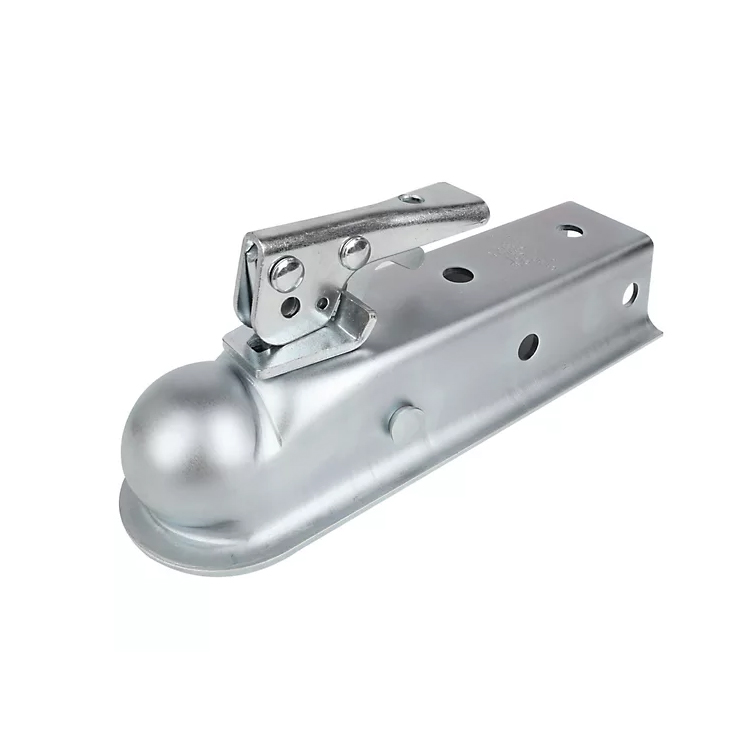
When it doesn't fit onto the hitch ball correctly, even the strongest trailer coupler turns into a liability. A proper fit allows for seamless coupling and uncoupling operations while ensuring that the coupler socket diameter perfectly matches the ball diameter with little play. A coupler made to precise specifications is needed for each of the standard ball sizes, which are 1-7/8 inch, 2 inch, 2-5/16 inch, and 3 inch in diameter. While inadequate space makes coupling challenging and may prevent the latch mechanism from properly engaging, excessive clearance causes hazardous movement that speeds up wear, produces noise, and may result in an unintentional separation. Fit quality is determined by manufacturing accuracy, which is why improved production skills are important. Tolerances of a thousandth of an inch may be maintained across thousands of units in facilities with automated robot production lines and CNC processing. Every trailer coupler that leaves the factory will function exactly the same in the field thanks to this uniformity. To effectively match with the curvature of the ball, the internal socket geometry must be completely spherical, and the latch mechanism must engage positively without needing an excessive amount of power. Examining a China trailer coupler supplier's measurement and quality control methods helps determine whether or not they can provide the exact fit your application requires.
Dimensional Accuracy and Tolerance Control
The effectiveness of a trailer coupler in carrying out its primary purpose of establishing a safe, articulating connection is directly impacted by manufacturing tolerances. For high-quality couplers, the socket interior must be machined or shaped to match the ball diameter with the proper clearance, usually 0.005 to 0.015 inches. This narrow tolerance range allows for typical production variances and guarantees smooth performance while preventing excessive play. The smooth surfaces required for a good fit and long service life are produced by production techniques like progressive stamping, which are followed by secondary operations like polishing and deburring. To ensure dimensional correctness, quality manufacturers use stringent inspection procedures throughout the manufacturing process. Statistical process control systems, go/no-go gauges, and coordinated measurement equipment guarantee that each trailer coupler satisfies requirements. The dimensions of the latch mechanism are similarly important; the locking parts must firmly engage to avoid unintentional release while yet enabling operators to effectively couple and uncouple trailers. You may be sure that fit-related performance concerns won't jeopardize your operations when purchasing from a China trailer coupler manufacturing by asking for dimensional inspection reports and learning about their quality control methods.

Compliance with Safety Standards and Regulations
Regulatory compliance is a legal necessity and a fundamental measure of safety and quality; it is not a choice. Depending on where the equipment is used, trailer couplers must adhere to standards set by the National Highway Traffic Safety Administration, SAE International, and other international organizations. In order to guarantee that couplers operate properly in a variety of settings and applications, these standards include minimum strength criteria, dimensional specifications, testing procedures, and labeling requirements. Operators that use non-compliant trailer coupler components run the danger of legal liabilities, insurance issues, and—most importantly—real safety hazards. Reputable producers maintain certificates that attest to their dedication to compliance and quality. While ISO 14001 environmental management and OHSAS 18001 occupational health and safety certifications show responsible manufacturing practices, ISO 9001 quality management certification guarantees methodical approaches to production uniformity. Verifying these certificates and asking for compliance documents for certain items when assessing a China trailer coupler wholesale provider shields your company against inferior parts. To ensure they meet or surpass published requirements, compliant couplers are put through a thorough testing process that includes static load tests, dynamic load cycles, corrosion resistance assessment, and latch mechanism endurance testing.
Certification Documentation and Testing Verification
Thorough documentation distinguishes reputable, high-quality trailer coupler producers from vendors selling dubious goods. Test reports demonstrating load capacity verification, material certificates verifying alloy composition and mechanical qualities, and conformity statements citing relevant standards are all examples of correct certification. Strong quality assurance processes help manufacturers create product quality files as soon as production starts, documenting manufacturing specifics, test results, and inspection findings for traceability. When looking into field failures or proving due diligence in court, this material becomes crucial. Compliant trailer coupler testing procedures include fatigue testing, which simulates years of service through repeated load cycles, environmental testing, which assesses corrosion resistance and performance across temperature extremes, and proof load testing, which subjects the assembly to forces greater than its rated capacity to ensure sufficient safety margins. Manufacturers that produce authentic, high-quality trailer couplers are happy to provide test findings and invite customers to visit their facilities. Although the expense of thorough testing and certification is increased, this investment immediately results in lower failure rates, improved safety, and a cheaper total cost of ownership due to longer service life and less liability exposure.
Integration of Manufacturing Excellence in Performance
It is impossible to overestimate the connection between trailer coupler performance and manufacturing capabilities. Reliable couplers are defined by their strength, fit, and compliance, all of which are directly made possible by advanced manufacturing processes. While CNC processing produces complicated geometries with repeatable precision that are unattainable with manual processes, modern facilities using laser cutting accomplish accurate blank preparation that removes beginning material irregularities. Instead of degrading the metal by prolonged cold working, progressive stamping processes produce components in many successive steps, creating complex geometries while keeping material strength through controlled deformation. Surface finishing techniques have a big influence on lifespan and performance. On aluminum alloy trailer couplers, anodizing produces strong, corrosion-resistant surfaces, and electrophoresis coating offers consistent coverage, even in recessed regions, preventing corrosion from starting in difficult-to-reach places. Excellent durability and chemical resistance are provided by powder coating, which shields the base metal from environmental deterioration that might potentially jeopardize structural integrity. When paired with excellent primary production, these secondary processes set exceptional trailer coupler goods apart from commodity equivalents that could seem identical at first but break down quickly under demanding circumstances.

Quality Systems and Continuous Improvement
Reputable trailer coupler manufacturing plants have extensive quality control systems that go beyond simple inspection. By keeping an eye on important variables in real time, statistical process control may identify process drift before it results in parts that don't meet specifications. Instead of just separating the good from the poor, engineers collaborate closely with quality inspectors to look into anomalies and put remedial measures in place that address the underlying reasons. Consistent performance is guaranteed across manufacturing batches and throughout time as staff and equipment ages thanks to this methodical approach to quality, which is confirmed by certifications like ISO 9001 and five-star green supply chain management. Programs for continuous improvement stimulate creativity in both processes and products. Excellence-driven manufacturers fund research and development teams that investigate novel materials, improve designs using field performance data, and integrate cutting-edge technology to expand capabilities. Because of this commitment to progress, trailer coupler solutions nowadays feature technical improvements that address wear patterns, failure modes, and customer feedback, as well as lessons acquired from millions of service hours. Assessing a trailer coupler supplier's dedication to innovation and ongoing development gives you a sense of how competitive and competent they will be as your needs change.
Conclusion
Trailer coupler performance ultimately depends on the intersection of strength, fit, and compliance—three factors that must work in harmony to deliver safe, reliable towing operations. Understanding these performance factors empowers you to make informed sourcing decisions that prioritize long-term value over initial cost savings, protecting both your equipment investments and the people operating them.
Cooperate With Qingdao RUIRUI Machinary Co., LTD.
Qingdao RUIRUI Machinery Co., LTD. is a top China trailer coupler manufacturer and supplier that uses cutting-edge production techniques and a steadfast dedication to quality to provide the performance you want. With eight fully automated robot manufacturing lines, our factory consistently produces 130,000 pieces a year. In order to fulfill a variety of application needs, we specialize in the production of trailer couplers utilizing progressive stamping, deep drawing, CNC machining, and laser cutting. We deal with materials including mild steel, cold rolled steel, stainless steel, and aluminum alloys.
Beyond primary forming, we also provide anodizing, powder coating, plating, electrophoresis, polishing, and etching as part of our extensive metal fabrication services, which guarantee your trailer couplers have the best possible surface protection for a longer lifespan. With ISO 9001, ISO 14001, ISO 20000, and OHSAS 18001 certifications, we uphold systematic quality control that monitors every product from raw materials to final inspection. In order to guarantee that every premium trailer coupler that leaves our plant satisfies your specifications and legal requirements, our engineers create comprehensive product quality files and adhere to ISO and IAFT quality standards.
As an established China trailer coupler factory offering China trailer coupler wholesale opportunities, we provide OEM support for custom applications, short delivery times through efficient production scheduling, and professional packaging ensuring your components arrive ready for installation. Whether you need standard trailer coupler for sale or custom-engineered solutions, our experienced R&D team delivers innovative designs backed by over 15 years of management experience. Our competitive trailer coupler price structure, combined with superior quality, makes us your ideal partner for both ongoing supply and development of specialized coupling solutions. We export to more than 80 countries globally and welcome inquiries for technical support, bulk orders, and long-term supply agreements. Contact our team at info@qdkshd.com to discuss your trailer coupler requirements, request samples, or schedule a facility tour. Bookmark this resource for future reference as you evaluate suppliers and make critical procurement decisions that impact your operational safety and efficiency.

References
1. Society of Automotive Engineers. "Performance Requirements for Coupling Devices and Fifth Wheels." SAE J684 Standard. SAE International Technical Committee.
2. National Highway Traffic Safety Administration. "Federal Motor Vehicle Safety Standards: Trailer Hitches and Couplers." FMVSS No. 133. U.S. Department of Transportation.
3. Anderson, Michael R., Thompson, David L. "Mechanical Analysis of Trailer Coupling Systems Under Dynamic Loading Conditions." Journal of Transportation Engineering and Safety Research. American Society of Civil Engineers.
4. International Organization for Standardization. "Road Vehicles—Mechanical Coupling Between Towing Vehicles and Trailers—Strength Testing." ISO 3584 Standard. ISO Technical Committee 22.
5. Brown, Jennifer K., Martinez, Carlos E. "Material Selection and Fatigue Performance in Heavy-Duty Trailer Coupling Components." International Journal of Automotive Engineering and Manufacturing. Society of Manufacturing Engineers.

Send Inquiry
Related Industry Knowledge
- Best RV Lifting Machinery Jacks for Motorhomes and Trailers
- Standard Trailer Hitch Ball Sizes | How to Choose
- What Makes a Heavy Duty Locking Hitch Pin Reliable for Travel?
- What Are the Advantages of Using an Adjustable Tow Arm Adapter in RV and Trailer Manufacturing?
- How Can Carbon Steel Forged Automobile Brake Pads Reduce Operational Costs in the Long Run?
- Bulk Discounts: Commercial-Grade AC Brackets Shipped Worldwide
- Can Custom-Tailored Trailer Arm Locker Fasteners Enhance Productivity in Your Manufacturing Line?
- How do I address a loose or worn trailer coupler?
- What metal fasteners can be used with aluminum?
- What is a trailer jack bottom plate used for?